
Standard Chartered on Friday lowered India's growth forecast for the current financial year to 4.7 per cent from earlier 5.5 per cent, citing "upside risks" to inflation and fiscal deficit.
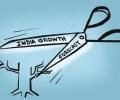
Global forecasting firm Oxford Economics on Monday revised downwards its India GDP growth forecast for 2021 to 10.2 per cent from 11.8 per cent previously, citing the country's escalating health burden, faltering vaccination rate and lack of a convincing government strategy to contain the pandemic. Oxford Economics also said that notwithstanding the likelihood of further mobility restrictions, it expects India's targeted lockdown approach, less stringent restrictions, and resilient consumer and business behaviour to mitigate the economic impact of the second wave.

Manufacturing activities in India fell to a five-month low in September as new orders rose at a softer pace, which tempered production growth, a monthly survey said on Tuesday. The seasonally adjusted S&P Global India Manufacturing Purchasing Managers' Index (PMI) fell to 57.5 in September, down from 58.6 in August -- the lowest in five months. The September PMI data pointed to an improvement in overall operating conditions for the 27th straight month.

The GST revenues for August 2023 have shown a growth of 11 per cent year on year due to increased compliance and less evasion, Revenue secretary Sanjay Malhotra said on Friday. The collection from Goods and Services Tax (GST) was Rs 1,43,612 crore in August 2022. "Roughly numbers are in the range of 11 per cent year on year growth as in earlier months," Malhotra told reporters.

The finance ministry has cautioned that global and regional uncertainties and domestic disruptions may keep inflationary pressures elevated in the coming months, warranting "greater vigilance" by the government and the Reserve Bank of India (RBI). "Russia's decision to terminate the Black Sea grain deal, along with dry conditions in major wheat-growing areas, caused a price spike in cereals. Domestic factors like white fly disease and an uneven distribution of monsoon exerted pressure on vegetable prices in India," the ministry said in its latest Monthly Economic Report for July, released on Tuesday. However, the report maintained, the recent price surge in certain food items "is expected to be transitory". "Tomato prices are likely to decline with the arrival of fresh stocks by the end of August or early September.

India's prices are rising faster than many of its emerging market peers. The country's inflation print for May at 4.25 per cent is a marked reduction from the levels seen in May 2022 (7.04 per cent). However, even though the inflation rate remains within the Reserve Bank of India's medium-term target of 4 per cent, with a 2 per cent margin on either side, it continues to be higher than China, Russia, and Brazil.
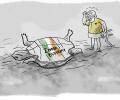
The International Monetary Fund (IMF) on Tuesday slashed India's growth forecast for 2022-23 (FY23) by 80 basis points to 7.4 per cent, citing less favourable external conditions and rapid policy tightening by the central bank. In its update to the April World Economic Outlook, the IMF said that though a global recession in 2022 was ruled out with a growth estimate of 3.2 per cent, the balance of risks was squarely to the downside, driven by a wide range of factors that could adversely affect the global economic performance. "The risk of recession is particularly prominent in 2023, when in several economies growth is expected to bottom out, household savings accumulated during the pandemic will have declined, and even small shocks could cause economies to stall.

With nearly 100 countries closing national borders during the past month, the movement of people and tourism flows have come to a screeching halt. The contraction could be even higher if governments fail to provide income support and help boost consumer spending.

'We should look at is full year's growth rather than quarter numbers.'

India's budget for the fiscal beginning April focuses on giving a boost to the ongoing economic recovery through a sharp increase in capex spending but is short on major growth-enhancing structural reform announcements, Fitch Ratings said Wednesday. The deficit targets present in the Union budget 2022-23 by Finance Minister Nirmala Sitharaman on Tuesday "are a bit higher than our forecasts when we affirmed India's 'BBB'/Negative sovereign rating in November," said Jeremy Zook, director and primary sovereign analyst for India, Fitch Ratings. While it was widely expected that the fiscal deficit will be lower than the targeted 6.8 per cent of the GDP in the current fiscal year ending March 31, 2022, Sitharaman put the number at 6.9 per cent.

On Aug 11, the Chinese central bank surprised markets by devaluing the yuan by nearly 2 per cent.
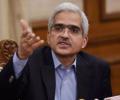
The Reserve Bank of India on Thursday decided to keep policy rate unchanged for third time in a row as it maintains heightened vigil on inflation. The rate increase cycle was paused in April after six consecutive rate hikes aggregating to 250 basis points since May 2022.

Moody's on Thursday slashed India's growth estimate for the current year to 9.1 per cent, from 9.5 per cent earlier, saying high fuel and fertilizer import bill could limit the government's capital expenditure. In its 'Global Macro Outlook 2022-23 (March 2022 Update): Economic Growth will suffer as fallout from Russia's invasion of Ukraine builds' report, the rating agency said Russia's invasion of Ukraine has significantly altered the global economic backdrop through three main channels -- spike in commodities prices, risks to global economy from financial and business disruption and dent in sentiment due to heightened geopolitical risks. It said Russia is the only G-20 economy that will contract this year and forecast that its economy will shrink 7 per cent in 2022, and 3 per cent in 2023, down from projected growth of 2 per cent and 1.5 per cent respectively, before the invasion of Ukraine.

The weak April-June quarter (first quarter, or Q1) results of the largest listed specialty chemical maker, SRF, and multiple global headwinds for the sector are expected to weigh on the prospects of Indian specialty chemical companies in 2023-24 (FY24). Stocks in the sector (down 7-18 per cent) have underperformed the benchmarks (up over 10 per cent) in the past three months, and given the multiple challenges, the trend is likely to continue. Kotak Institutional Equities expects a very weak quarter (Q1FY24) for the sector due to destocking, demand weakness across certain critical end-use industries, and price erosion amid intense competition from Chinese suppliers.

'Data-dependence means you can raise or drop rates. The present stance is only for raising rates.'

'If you look at the order books of capital equipment companies or money deployed on the ground, there is forward movement in terms of actual investment by the private sector.'

Major global indices - the Nasdaq, Bovespa, Seoul Composite, S&P 500, Dow Jones, S&P BSE Sensex, NYSE, DAX, Nikkei and, CAC 40 - have all gained 37 per cent to 75 per cent since their respective March 2020 low.

Chief Economic Advisor (CEA) V Anantha Nageswaran on Thursday said describing India's recovery as 'K-shaped' was wrong as both rural and urban economies were recovering, albeit at different paces. Speaking to reporters at the Finance Ministry, Nageswaran said the gross domestic product (GDP) growth print for the recent October-December quarter (Q3FY23) will likely be revised upwards. "The notion of using the letter 'K' to denote urban and rural is somewhat wrong because it is almost as if one is growing and one is contracting. "I would say one segment's slope is more positive, and the other one slope is less positive but it is positive," Nageswaran said.

Amid rising geopolitical risks, a vast majority of Indian CEOs have indicated in a survey that they are reducing or planning to reduce operating costs, even as they are more upbeat than their global peers on their country's economic prospects. However, most of the companies do not plan to cut their headcount or salaries, found the annual Global CEO Survey released by consultancy giant PwC here on the first day of the World Economic Forum meeting on Monday. The survey also found that about four in ten CEOs (40 per cent of global and 41 per cent of India respondents) do not expect their companies to be economically viable in 10 years if they continue on their current path.

The advanced economies have been experiencing their longest period of slow growth in many decades.

Tokyo -- the songs Japan, Love In Tokyo and Sayonara from the 1966 Hindi film automatically pop up in the mind -- is buzzing and crowded like any other metropolis, discovers Deepa Gahlot. The modern apartment blocks are built cheek by jowl, so close together that one can open the window and borrow sugar from the neighbour in the next building. One of the fears of the Indian traveller is the unavailability of vegetarian food. Every city and town in Japan has an array of Indian restaurants that serve every variety of cuisine, right from Gujarati to Punjabi to Andhra and Kerala meals.

Monetary policy easing in India puts it out of step with the United States, the world's largest economy, where interest rates are expected to rise later this year

Wholesale price inflation remained in the negative territory for the fourth month in a row in July at (-)1.36 per cent, even though prices of food items, especially vegetables, skyrocketed. The inflation, however, has inched up from (-)4.12 per cent recorded in June fuelled by 62.12 per cent rise in vegetable prices. In July last year, wholesale price index (WPI) was 14.07 per cent.
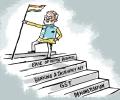
As the Ukraine conflict impacts the global GDP, India is projected to grow by 6.4 per cent in 2022, slower than the last year's 8.8 per cent but still the fastest-growing major economy, with higher inflationary pressures and uneven recovery of the labour market curbing private consumption and investment, according to a UN report. The UN Department of Economic and Social Affairs said in its World Economic Situation and Prospects (WESP) report released on Wednesday that the war in Ukraine has upended the fragile economic recovery from the pandemic, triggering a devastating humanitarian crisis in Europe, increasing food and commodity prices and globally exacerbating inflationary pressures. The global economy is now projected to grow by only 3.1 per cent in 2022, down from the 4.0 per cent growth forecast released in January 2022.

In putting the country's economy back on the rails, it is best that Narendra Modi and Arun Jaitley draw on grass-roots feedback and their own practical sense and native wisdom without allowing themselves to be sucked into the quicksand of economic punditry, says B S Raghavan.
India's headline retail inflation is expected to moderate further in the months to come, as low wholesale inflation will transmit to consumer prices, the Ministry of Finance said in its latest monthly economic review (MER) on Monday. "Inflationary pressures eased in February, with slight moderation in Consumer Price Index (CPI) inflation and Wholesale Price Index (WPI) inflation softening to a 25-month low. "With WPI inflation easing, its transmission to CPI inflation is soon expected," the MER for February said.

CPI inflation could fall marginally but stay above RBI's comfort level.

As the House took up the debate on Motion of Thanks on the President's Address, the Bharatiya Janata Party launched a frontal attack on opposition parties specially the Congress for their stance against the CAA, saying they were trying to divide the nation.

Questioning the methodology of CSO in computing economic growth projections, the Planning Commission today said it has ignored the rising growth trend while working out estimates for 2012-13.

Reserve Bank will have to constantly re-assess the "dynamic and fast changing situation" and tailor its actions accordingly, Governor Shaktikanta Das said during the recent meeting of the Monetary Policy Committee (MPC) which decided to maintain status quo on key interest rate. According to the minutes of the six-member MPC meet released by Reserve Bank of India (RBI) on Friday, the five other members had also expressed a similar opinion amid the ongoing Russia-Ukraine conflict's impact on the global and domestic economies. MPC, which held its meeting from April 6-8, unanimously decided to keep the borrowing costs unchanged at a record low for the 11th time in a row in a bid to continue supporting economic growth despite inflation edging higher in the aftermath of Russia-Ukraine conflict.
Higher for longer' may be the narrative in the developed markets, but interest rates might not stay high for very long in India, with a section of the market expecting rate cuts to begin this year. The six-member Monetary Policy Committee of Reserve Bank of India (RBI) decided to keep interest rates unchanged at 6.5 per cent in the April review - after hiking the policy repo rate in six previous meetings. RBI Governor Shaktikanta Das emphasised that the pause was only for the April policy and that the central bank was ready to act if the situation demanded.

Global funds, according to Christopher Wood, global head of equity strategy at Jefferies, are now beginning to pay more attention to India with the market now offering 30 companies with a market capitalisation over $25 billion.

Manufacturing sector activities in India moderated in June from a 31-month high in May, but output remained in the growth territory, as new work orders expanded sharply amid favourable demand conditions, a monthly survey said on Monday. The seasonally adjusted S&P Global India Manufacturing Purchasing Managers' Index (PMI) fell from 58.7 in May to 57.8 in June. Despite the fall, the headline figure pointed to a considerable improvement in operating conditions, the survey said, adding that the demand strength positively impacted several other measures such as sales, production, stock building and employment.

Maruti will launch its first electric vehicle (EV) in the next financial year (FY24), and will roll out six EVs in the country by FY30, the automaker's parent firm Suzuki said on Thursday.

While the economy seems to be on a firm growth path, the fight against inflation is not over yet. Shaktikanta Das seems to be in no hurry. After playing well through a five-year Test match, he doesn't want to get out hit wicket, observes Tamal Bandyopadhyay.

'As China's reopening euphoria fizzled out on the back of some disappointing economic data, we saw inflows coming back to India with full force in the past 3-4 months.'

Rating agencies Crisil and Icra on Monday revised down their India growth projections for the current fiscal and the second quarter mainly due to the ripple effect of slowdown in global growth and mixed crop output. Crisil downgraded the India growth forecast by 30 bps to 7 per cent while Icra pegged the economic expansion at 6.5 per cent for the second quarter of FY2022-23. "We have revised down our forecast for real gross domestic product growth to 7 per cent for fiscal 2023 from 7.3 per cent, primarily because of the slowdown in global growth that has started to impact our exports and industrial activity.

Brent crude oil prices may rise to $110 a barrel in 2023, up nearly 33 per cent from the current levels, said analysts at Morgan Stanley, in a recent note. This is, however, lower than the peak level of nearly $127 touched earlier in 2022 as geopolitical concerns took centre stage amidrising demand. "Looking ahead, Brent oil price growth will decelerate even more in the coming quarters. "This comes even as our global oil strategist expects a rise in oil prices back to $110 a barrel by the second half of 2023.

From the Sensex pack, NTPC, Bajaj Finance, IndusInd Bank, UltraTech Cement, Bajaj Finserv, State Bank of India, Tata Motors, ITC, Power Grid and Larsen & Toubro were the biggest gainers. IndusInd Bank climbed 2 per cent after the company on Tuesday reported a 30 per cent jump in consolidated net profit in April-June quarter at Rs 2,124.50 crore, helped by core income growth and lower bad loan provisions.
India's economic growth has slowed to a three-year low of 5.3 per cent in the April-June quarter of the current fiscal.
